Monday, June 21, 2021

Iago - Why?


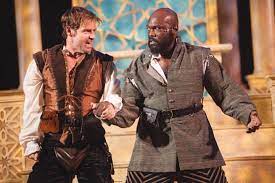
At the very heart of Othello lies the question of Iago’s motive for what he did. Iago stands in a long line of Shakespearean villains who pursue their perverse course with delight. At one level we are horrified by the depth of their villainy but at another level we are fascinated by them. We fascinated by the skill with which he conceals his villainy from the rest of the cast. While being appalled by the purpose of the villain, we, as the audience, are flattered by the knowledge that we alone fully aware of the purpose revealed to us through his soliloquies. In a way, we the audience, have the dubious honour of being the villain’s accomplices – though we have access to the purpose of the villain, we are prevented from revealing it to the victims of the villain’s plot by dramatic conventions. 

Despite our awareness of the truth of the villain, that s/he is “subtle, false and treacherous” (Richard III, I.i. 37), we are attracted by him/her. The reason for this could be that we can indulge ourselves in our fascination of the evil vicariously because we are at a safe distance from the figure of evil so that they could not harm us (?). In a way, the experience could also be cathartic.        

The ideas put forward by Machiavelli in The Prince (1513) seem to have a profound impact on the construction of the Renaissance/Shakespearean villain. In Shakespeare’s days the term Machiavelli was synonymous with hypocrisy and deceit. Villains in the Renaissance theatre often invoke Machiavelli in defining their thinking and actions. However, Iago departs from this tradition probably due to his sense of uniqueness/ egoism – he believes that he is one of a kind. However, Act II.iii. 326-329 he makes an allusion to The Prince:     

And what’s he then, that says I play the villain,

When this advice is free I free, and honest,

Probal to thinking, and indeed the course

To win the Moor again?

Iago take pride in playing the “honest Iago”; therefore, the actor who plays the role Iago, would have to play a part in which the part plays another part. 

 Only the audience and Roderigo are privy to the fact that Iago is a villain. Throughout the play, Iago is associated with the term “honest” – true-hearted, trustworthy, straightforward, forthright and sincere. Iago had acquired a reputation of a plain-speaking practical sort of a person as a soldier. Off the battlefield, he appears the very epitome of dutifulness and dependability. It is a sign of Iago’s genius that not only had he been able to create such an image but also he had been able to sustain that image to the very end in the eyes of all the characters. He takes immense pleasure in savoring the success of his image. In the first of his frequent aides he confides in the audience of the inner-workings of his mind thus:

In following him, I follow but myself.

Heaven is my judge, not I for love and duty.

But seeming so, for my peculiar end.

For when my outward action does demonstrate

The native act, and figure of my heart,

In complement extern, ‘tis not long after,

But I will wear my heart upon my sleeve,

For doves to peck at: I am not what I am. (I.i 58-65)  

True Iago feels only contempt for Roderigo and refers to him using the most unbecoming appelations such as snipe, trash and quod while pretending to be his benefactor whose sole objective is to ensure that Roderigo gets his heart’s desire. When he superflues, and even dangerous to his cause, Iago kills Roderigo without a hesitation. While it may not have taken much to gull Roderigo, fooling Cassio should have offered a greater challenge. Yet, this too Iago manages with aplomb. He masterminds the plot to disgrace Cassio so that he would be removed from his post without drawing a shade of suspicion on him. In fact Othello assumes that Iago is out of his “honesty and love doth mince the matter, Making it light to Cassio” (II.iii 238-239).  He encourages Cassio to appeal to Desdemona to get his position back so that he could find an opportunity to strengthen the suspicion he aimed to plant in Othello’s mind regarding the true nature of their relationship. His tongue-in-the-cheek announcement in II.iii323 that his advice is free and honest “probal to thinking and indeed the course, to win the Moor again” gives us an insight to how Iago operates and the complexity of Iago’s villainous plots.

Similarly, in IV.i, when Ludovico is appalled by Othello slapping Desdemona in front of him Iago plays the loyal friend and says “its not honesty in me to speak What I have seen and known” (275-76) and damns Othello further by his apparent reluctance to discredit his lord. When Othello calls Desdemona a whore Iago pretends to sympathize with her and be shocked by Othello’s suspicions – the suspicions he himself had planted and carefully nurtured. After wounding Cassio subsequent to the failed plot of get him killed by Roderigo he pretend concern for Cassio thereby presenting himself as witness to the crime and turns upon his pawn and injures him fatally – killing two birds with one stone: he does not have to pay back the gifts and his part in the plot would not be revealed.

His reputation as “honest Iago” – in its many shades - is so firmly established in the minds of all the actors, that no one casts any aspirations on his trustworthiness, etc. throughout the play until the very end.   


Go and catch a falling star - John Donn


The three stanzas of the poem rhymes ababccddd. There is uniformity in the number of lines and even in the shape of the poem. One might see this quality as a male poet privileging order and reason over chaos which usually is associated with women. Women were idealized, or even idolized, in Courtly Love Poems as pure faithful Madonnas. This, of course, is unrealistic. Unlike many Renaissance poems idealizing women, “Song” satirizes women using hyperbole – extreme exaggeration. The poem may sound antifeminist (misogynistic), but it must be viewed in the context of metaphysical poems. Therefore, it should be read not so much as a condemnation of women but as a criticism of CLP. In fact, Donne, far from being a misogynist, had been described by one of his friends as “a great visitor of ladies.” Therefore, it is more prudent to read the “Song” is a perfect example of Donne’s playfulness with metaphysical conceits and female sexuality.

Imagine a lover who has fallen hard for that perfect woman once too often – and now has a cynical view on all women. The poem opens with a list of impossible tasks: catching a falling star[1] – a meteorite, becoming pregnant with the aid of a mandrake root[2], and finding out where the time we spent harbour itself, 2. Who cleft the Devil’s foot, 3. How to hear Mermaids[3] singing without losing one’s head 4. How to keep those who are envious from harming others, and 5. What would bring good fortune to honest people – illustrating the impossibility of finding a beautiful woman who also happens to be honest.

The second stanza focuses on feminine virtues. The poet continues his monologue with the imaginary listener and tells him that even if the listener were to go on a quest around the world looking for a woman both beautiful and faithful he would upon his return tell the poet that he had not come across one.

In the third stanza, Donne continues his argument based on the hypothesis that if the listener were to find a woman who was both faithful and beautiful, she would become fickle within the short time it would take the listener to walk next-door and report to the poet of his discovery, not just to one person but two or three.     

Donne uses a startling series of unconventional images. In addition, Donne also uses unusual comparisons, or conceits, and his argumentative style. In this poem, the poet brings in a series of arguments like a consummate lawyer to prove his point. The argumentative style gives the different parts of the poem a sense of interconnectedness while forcing the reader to pay close attention to what is being said.

[1] A falling star is a bright beautiful thing that is reduced to ashes in the end. People make wishes when they see one. Donne, influenced by the increasing focus on the sciences, is trying to show that trying to catch an honest beautiful woman is like trying to catch a meteorite – both attempts would be disillusioning as well as disastrous.

[2] A plant used in witchcraft. It is also used as an aphrodisiac, a cathartic, a poison, and a narcotic. Making a baby with the aid of a mandrake root is an unnatural act – a beautiful woman who is faithful is also unnatural; beautiful women are by nature fickle – according to the voice. However, in this context, making a baby is impossible as the poet is asking a man to become pregnant by a male plant.   

[3] Singing of the mermaids, or more correctly the sirens, lure unsuspecting sailors to their doom according to Homer in The Odyssey. Similarly, women, according to the voice, lure men to their destruction. 

Sonnet 73 - William Shakespeare


That time of year thou mayst in me behold
When yellow leaves, or none, or few, do hang
Upon those boughs which shake against the cold,
Bare ruin'd choirs, where late the sweet birds sang.
In me thou see'st the twilight of such day
As after sunset fadeth in the west,
Which by and by black night doth take away,
Death's second self, that seals up all in rest.
In me thou see'st the glowing of such fire
That on the ashes of his youth doth lie,
As the death-bed whereon it must expire,
Consum'd with that which it was nourish'd by.
This thou perceiv'st, which makes thy love more strong,
To love that well which thou must leave ere long.

In this sonnet Shakespeare continues his meditation on aging and approaching death. However, one may not be misled and think of Shakespeare as a doddering old man. It is my belief that there is more than a touch of the hyperbole in his agonizing preoccupation with his age.

In the first 12 lines of the sonnet Shakespeare presents his young friend with three images of himself as an aging man: a bleak late autumn scene, twilight, and an image of a dying fire.

The poet in the first four lines presenting the image of the bleak late autumn says, when his young friend looked at him, he would see an image of those times of the year when the leaves were yellow or have fallen, or when the trees had no leaves at all and the bare branches where the sweet birds recently sang shiver in anticipation of the cold winter to come. The term “leaves” stand for the number of years left for the poetic persona to live. The leaves are yellow: old age and sickness. The unusual reversal of “none, or few” highlights quite poignantly the fear the poetic persona feels about the very little time he feels that he has left to live. The reference to the choirs evokes an image of a ruined church. Art that is believed to be divinely inspired by many found its highest forms of expression in churches in Britain during the Renaissance. However, during the reign of Henry VIII many of the great churches that sponsored arts in Britain were ransacked and destroyed. Therefore, it is quite natural for Shakespeare who would have seen many of those ruined great churches where great music had been composed and offered to God in choric performances to see the almost leafless branches vacated by song birds as ruined church choirs. Reading between the lines, this might be an indication of his fear of losing his own ability to produce and perform art with the onset of old age. An artist who cannot produce and perform art would surely look like a leafless branch or a ruined choir vacated by its occupants. The branches vacated by song birds could also be read as a reference to those artists who used to seek the poetic persona out when his sap was green. They have left him in his old age. At the same time, this metaphor pays a complement to the receiver of the poem with the allusion that he unlike the birds that have left the tree has not left the aging poet.          

In lines 5-8, Shakespeare presents himself as twilight. He says that his friend would see in him the twilight that remains after the sunset fades in the west, which by and by is replaced by black night, the twin of death. The poet quite casually slips in a euphemism and signals to his friend that his death might not be too far off when he says that the night that comes after twilight is really “Death’s second self, that seals up all in rest.”  

In lines 9-12, Shakespeare compares himself to a dying fire. He invites his friend to see in him the remains of a fire glowing feebly atop the ashes as if it lay on its own deathbed; the ashes produced by the logs would ultimately smother the fire. The term “ashes” recalls to the mind the Christian burial prayer “Ashes to ashes, dust to dust …” further cementing the idea that things born must eventually die.

The Renaissance was an age that wholeheartedly encouraged the practice of the late Classical philosophy carpe diam. It is believed that Shakespeare himself died of a fever contracted after a bout of heavy drinking with his friend Ben Jonson. So, being reduced to an old wreckage robbed of his music would be the last thing the poet would have wanted for himself. The heart-breaking reality is that the poet knows that despite his aversion to aging, there is no stopping of it: seasons come and go, day time gives in to night, and once roaring fires die when the fuel runs out.  

In the final couplet, the poet says that the young man would see all these things, and they would make his love stronger, because he loved even more what he knew he’d lose before long. The sonnet is either a declaration of faith in the strength of the relationship between Shakespeare and his young male friend or as a more cynical person would put it a wistful yearning for something to remain unchanged despite change.     

It must be said that the images Shakespeare has selected to illustrate the point that he is aging and his death might not be too far off are all full of colours that are rapidly being overtaken by darkness. Still, the colours are still there. One might say that it is the dying fire that burns brightest.

Friday, December 7, 2018

Every Day Use - Alice Walker

In Feminism and American Literary History, Nina Baym succinctly captures the method used by male writers to chart the developmental trajectory of their male protagonists by the metaphor of “the whaling ship” (ix). As the term “whaling ship” implies, male bildungsromans such as Invisible Man narrate a young male’s relentless individual quest for a self of his own. In contrast, female African American writers like Zora Neale Hurston, Tony Morrison, and Alice Walker make the maturation as well as the narration of the maturation of their female protagonists a product of a collective effort in which the stories of their lives are put together and transmitted by sisterhoods of women. Interestingly, Nina Baym calls this activity quilting.

African American writers like Walker grew up in a hostile economic, political, and social climate. In response to the hostile and inaccurate portrayals of his race, W E B Du Bois advocated an Uplift program to improve the image of African Americans in  the US society. The Uplift agenda presented fine and upstanding African Americans who conformed to the social mores of the day. Writers like Hurston, Morrison and Walker rejected the Racial Uplift efforts to present African Americans in a way that would accommodate the cultural standards of the white majority. Their work was different from their fellow Harlem Renaissance writers whom Hurston described as the "sobbing school of Negrohood" that portrayed the lives of black people as constantly miserable, downtrodden and deprived. Instead, writers like Walker celebrated the rural, southern African-American communities as they found them.

Male realist fiction vs. female fiction
Making of the USA had from the beginning been projected as a White Anglo-Saxon Protestant male project (Greenblatt). Writers like Walker create vaginal creative space for Black women in a dominantly White phallocentric culture. In “Everyday Use”, Walker focuses on the bonds between women of different generations and their enduring legacy.

Context
The temporal setting of “Everyday Use” is the late 1960s or early 1970s. The spatial setting is the rural America. ‘60s and ’70 were times in which many African Americans were making a collective effort at redefining their sociopolitical identity in the USA and celebrating their contribution towards making of the USA. Towards this end features of African American culture were sought out and examined in order to reconnect with the past. Black and African-American replaced the term Negro that had derogative connotations. Groups such as the Black Panthers and Black Muslims were created to resist discrimination against Blacks. Dee’s character represents the Cultural Nationalism of that period. Hakim-a-barber is a representation of the more militant of the nationalistic groups. Walker is critical of those like Dee and Hakim who misappropriate the ideals promoted by Black resistance groups.

Walker by making Mama, the subaltern, the narrator of the story gives a traditionally downtrodden group agency (Gayathri Spivak – Subaltern Studies). Mama tells the reader her story in her own way. The focal point of the story is the ongoing friction between Dee and her family which reaches its climax when Mama is forced to choose who should have the quilts.

Techniques:
Humor - Mama’s reaction to Dee’s and Hakim’s difficult-to-pronounce name – lightens the atmosphere
Use of dialect gives a sense of realism.

Irony - Dee and Maggie (Mama, too) have different perceptions on the use for the quilts. For Mama and Maggie they are practical household items. For Dee who basically views her mother’s people as country bumpkins who are stuck in the past the quilts are merely display items. But making a display item out of something meant for everyday use defeats its purpose. It is by incorporation them in the daily life that history could be kept alive.

Symbols 

The Quilts (the dasher, too) – symbolizes the bonds between women down the generations and their legacy that is threatened by people like Dee who have no understanding of how to keep it going. It was Aunt Dicie and Mama who had quilted the contested quilts. No such joint ventures would be undertaken by Dee and Maggie. When we look at women as guardians of history and culture created by men, the act of quilting acquires a special significance.  It was Mama and Dicie who had decided which patch of fabric to preserve out of the ones they had received from their various family members and in what order. Thereby, through quilting women assert agency. Dee does not understand that aspect of quilting and look at the quilts as old pieces of family history to be displayed.  

The Yard - The yard which appears in the first and last sentences of the story is a domesticated part of nature. Mama calls it an extension of the living room. In fact, she prefers it to the confines of the house. The yard is a part of Mama’s life that she is in complete control of.  

Mama

Mama, the narrator of the story, is a strong a strong woman with very few illusions about herself or her daughters, very much like the mothers in Walker’s poem “Women” that celebrated rural black womanhood. Mama is very much a product of the African-American heritage of the USA which required women to be as strong as men. She is in tune with her world and proud of her self-reliance. In addition, she is honest to the point of being cruel in her assessment of herself and her daughters, Dee and Maggie. She occasionally daydreams; yet, she remains essentially a practical woman. She displays her rejection of what Dee has become by awarding the quilts – the history of her family – to Maggie who would keep the tradition of quilting going.

Maggie

Disfigured by the fire and handicapped by lack of education, Maggie lives a secluded life with Mama. Her way of life is both a boon and a bane; for, while her isolation protects her, it also leaves her ill-equipped to deal with people like Dee. She looks at the world from behind doors. It is highly unlikely that even her marriage would change her. Maggie seems to resent Dee. However, the only time it manifests visibly is when she drops the stack of plates she had taken to the kitchen for washing up and slams the door shut on her way out when she hears Dee asking Mama for the Quilts that have been promised to her. However, her habitual deference to Dee’d wishes surfaces and she immediately offers the quilts to her younger sister. Mama probably sympathizing with Maggie as well as to display her resentment towards what Dee has become snatches the quilts off her younger daughter’s hands and gives them to Maggie.    

Dee

Dee aka Wangero, a representative of the Black intellectuals of the 70s, is in search of a selfhood. Already she has redefined herself to an extent with her new name and costume. However, both acts are testaments to her limited grasp of history, personal as well as racial. Walker presents an ironical view of the so-called Black intellectuals who attempted to reconnect with an African past ignoring their past and present in the USA itself. For people like Dee whose lives are far removed from the harsh realities of the lifestyle of people like Mama, what they encounter is upon their sojourns to the back and beyond is just a photo-op.

Dee who is judgmental by nature makes both Mama and Maggie uncomfortable. But both crave her approval. In return, she basks in their attention. Unflappable, arrogant and insensitive are words that can be used in describing Dee’s personality. Instead of being grateful for the sacrifices Maggie and Mama make on her behalf she slights them – it is the money collected for the house that was spent on her education. Dee who has come back to reclaim some parts of her heritage ends up rejecting it violently.

Themes

African-American Heritage in the history of the USA

People like Dee have misunderstood and misappropriated African-American history/heritage in the USA. She rejects her name Dee under the misconception that she had been named after some white person. By doing so she hurts her mother and insults the memory of her aunt. Her new name and clothes are just empty statements as she had no real understanding of her roots. For Dee history is something dead to be mounted on walls for people to look at.  She wants the dasher and the quilts as artefacts for display but not for practical use. In fact she takes the dasher off the butter churn, depriving Mama a way of making an essential part of her meals. For Mama and Maggie, the objects in their house connect them with the people who made and used them.  When Dee says that Mama and Maggie did not understand their legacy, it is ironic for it is Dee who does not understand it.

The Divisive Power of Education

Dee has been educated in civil rights, greater visibility, and zero tolerance for inequality. The type of education Dee has received had created a gulf between her and her family and separated her from a true sense of self, heritage, background, and identity, which only family can provide. Maggie on the other hand can barely make herself understood when she read. The irony is that Dee’s education has alienated her from her family while Maggie’s lack of education has stifled personality and deprived her of agency to a large extent.


Cat in the Rain – Ernest Hemingway


Genre

"Cat in the Rain" is an archetype of its genre, the short story. It is brief and relies more on suggestion than actual words, and therefore, it carries multiple meanings. Hemingway is quite economical with descriptions and dialogues.

Plot Analysis

Initial Situation

First there is a description of the environment in good weather, which means spring or summer, then a description of the momentary situation in the rain. This description creates an atmosphere that is sad, cold and unfriendly. To create this atmosphere Hemingway uses words such as "empty" or "the motorcars were gone". Later on, by looking at the relationship of the two Americans, you can see that this description was a foreshadowing of the state of the couple´s relationship: First it was nice, the spring-time of their love, and now there is only rain, their relationship got cold and unfriendly.
The couple stuck in their room. The description of the view from the window suggests that the woman has spent a lot of time looking at it. While she looked listlessly on the view outside her husband lay on bed absorbed in his book. The wife is an extrovert focused on lived life while her husband is focused on the internal world of books and ideas.

Conflict

Seeing the cat gives the wife a reason to move. Her dismissal of her husband's half-hearted offer to go down to fetch the cat suggests her dissatisfaction with him.

Complication

Downstairs, the wife encounters the hotelkeeper whom she refers to by the more dignified Italian term, “padrone”. When she looks under the table, however, the cat isn't there.

Suspense

The padrone gives the wife a sense of importance. The wife is strongly affected.

Climax 

After returning to the room without the cat the wife makes a list of the things she wants: long hair, a cat on her lap, her own silver, candles, springtime. Her husband, George, fed up, tells her to shut up and find something to read. The sentence that she wants it to be spring again stands for her huge wish for a new spring in her relationship

Denouement

The wife doesn't react to her husband’s scolding; instead, she looks out the window as the evening darkens around her. As she cannot have "long hair or any fun," she states that she wants a cat.

Conclusion

The room and the couple go back to the same state at the beginning of the story. It is at this point the hotel maid knocks on the door and announces that the padrone has sent a cat for "the signora." It's a gesture of thoughtfulness.

Setting

A small coastal village in Italy on a rainy day soon after the end of WWI. The couple in the story is staying at an upscale sea-side hotel and their room is located on the second floor facing the sea – this implies that the two people are well-off, and therefore, the reason for the palpable tension that permeates the story cannot be due to financial worries. The impact of WWI or the Great War, as it was called, is strongly felt throughout the story. WWI wiped out nearly an entire generation of young men in Europe and left the landscape as well as the minds of people deeply scarred. We are told that there is a War Monument in the middle of the town square. Such monuments are quite common in Europe. They represent lost hope for the near-and-dear of those hundreds of thousands who have fallen as well for the country at large. At the end of the war two groups remained: those who did not join the war and the emotionally and physically scared veterans. I have the impression that George belonged to the former category as implied by the inertia he displays throughout the story.

We are told that people from all over Italy come to pay their respects to the War Monument in the public garden. It's one of the things the wife sees from her perch at the window. We are also told that a lot of people come there to paint the sea-side view. The juxtaposition of the people painting the seaside view and those who come to pay respects to the WM in the opening paragraph points at the complexity of emotions experienced by people after the war came to an end. It was time of celebration as well as of sorrow. While some picked up the threads of their lives and tried to move on beyond satisfying their basic needs, some were trapped in the memories of their losses and pains experienced during the war. 

Hemingway sets the story on a rainy day. No one can go out on such a day – a sense of imprisonment/ entrapment and an acute disappointment hangs heavily in the air. People come to a sea-side resort to frolic out in the sun and not to gaze out of a closed window.
*      What parallels can you draw between the rainy day described in the short story and the state of the marriage of the American couple?

Point of View
The third person narrator relates the story using basic sentences, mostly statements. This encourages the reader to believe that the narrator is being strictly factual about the event he is narrating and that he has no personal opinions or biases. However, a closer reading implies that the narrator allocates more ‘space’ to what the wife is doing than to any other character, especially her husband George. Yet, in his defense one can say that George does very little to write about throughout the story.
The reader’s view of the hotel owner depends heavily on what the wife feels about how she is being treated by him. The third person narrator conveys her feelings, which she herself cannot fully articulate in speech. By using an omniscient narrator, Hemingway is able to convey both conscious as well as unconscious/ unarticulated thoughts of the characters.

Tone
The tone is controlled to the point of terseness. The husband and wife seem to have very different temperaments and are dissatisfied with one another. However, they don't talk about it. As Blake in his poem “The Poison Tree” had very successfully illustrated unexpressed dissatisfaction/anger festers and brings about ruin. Their trip to Italy could have been a last ditch effort to save their floundering marriage. However, their unexpressed differences seem insurmountable. Consequently, instead of the new surroundings pushing them towards each other, it seems to widen the emotional chasm between them. In such a situation being trapped in a hotel room on a rainy day in a foreign country with only each other for company would bring out the very worst in each other as implied by the terse exchanges between the two. Hemingway's sentences, both in the dialogues and descriptions, are clipped/terse/ minimalistic to the point of being rude.

The Title
The actions and the dialogues centre on a cat in the rain. However, why an American wife on a holiday in Italy with her husband should take a particular interest in a wet cat hiding under a table is a question that begs an answer. One might ask whether she sees any parallels between her own situation, trapped in a hotel in a foreign country on a rainy day with a neglectful husband, that makes her sympathize with the cat?
The title "Cat in the Rain" as opposed to" The Cat in the Rain" points at the possibility of any number of people/animals experiencing such a situation. The four words in the title are all monosyllabic words which are deceptively simple.

Cat: The absence of the articles "the" or "a" in the title makes the it sound like the title of a painting which points at the possibility of Hemingway trying to paint a word study of a couple of restless dissatisfied American tourist on a rainy day in an Italian sea-side village. Cats for the most part, are calm and collected. But a wet cat anything but.

In means to be in the middle of something—surrounded by it on all sides. In the story the cat is trapped under a table in downpour.

The - helps take the title a more literally - there is a cat and there is rain.

Rain - is ordinary yet fascinating. It invariably alters one’s mood.
Characters

Characters 
There are only a very few characters: the wife, husband, the hotel keeper, and the maid. Hemingway does not describe characters. Their characteristics reveal themselves through what they do/not do and speech.

The wife:

  • While sitting at the window and looking out at the square, the American wife spots a cat in the rain.
  • She tells her husband that she's going to go downstairs to get it.
  • Downstairs at the hotel, the wife has a brief exchange with the hotel owner about the rain. We hear about all the different little things she likes about him. She turns to go out into the square.
  • As she opens the door, a maid appears with an umbrella and goes out with her.
  • They look under the table but they do not find the cat, and return inside.
  • The hotel owner bows from his desk as the American wife passes. She is filled with a sense of importance in his presence.
  • The American wife returns to the hotel room where her husband is still reading.
  • She sits in front of a mirror, looks at her profile, and asks if she would look better with long hair. Her husband tells her she wouldn't, and she begins to talk about the things she feels she wants: a cat, long hair that she can feel and twist, candles, silver, and for it to be spring outside.
  • The husband tells her to shut up. She pulls back to one simple desire: she wants a cat.
  • As the room grows darker, there's a knock at the door. It's the maid, and she's holding a cat that the hotel owner asked her to bring to the wife.
We are told that the husband and wife are the only Americans in the hotel. We can't be sure why they're there. Their marriage is on the rocks. The woman is identified as the “wife”- it is the only identity the woman seems to have. By not naming her, Hemingway seems to want the reader to take her as a stereotype "American wife" of 1920s.
Her husband on the other hand has a name. Not having a name prevents the wife from being a real person on her own right. She is looked upon as an extension of her husband. While the husband reads, the wife sits at the window looking out. Her existence seems to revolve around her husband and house. In Italy she is out of her natural elements and completely dependent on her husband. Neglected by her husband who is bent on catching up on his reading on the rainy day, she expresses her dissatisfaction indirectly by saying that she wanted to rescue a cat. She seems to draw parallels between her situation and that of the cat in the rain – she is neglected, bored and miserably out of her element: "It isn't any fun to be a poor kitty out in the rain." The idea of rescuing a cat serves two purposes: she wants to draw her husband’s towards herself and the act of rescuing the cat offers her a temporary sense of purpose. Upon returning to the room after the unsuccessful rescue mission, she adds some more items to her wish list: her own silver, candles, and her own dining table – in short, she seems to want a home of her own. She also wants long hair, springtime and new clothes. These items are suggestive of her desire for a change in the state of her marriage for the better. This in turn points to the possibility that the wife and her husband at the moment are living a rootless life which makes the wife feel insecure. The wife seems to crave stability and security, two things a lot of people lose during times of war. This is why the wife is fascinated by the hotel owner, the padrone, who is established, dignified, and serious. She seems to resent the brash American-ness represented by her husband and herself in favour of the more sophisticated values of an older and more established Europe represented by the hotel owner. A "signora" is what the American wife unconsciously wanted to be and that is exactly how the padrone made her feel like.

George

Unlike the wife, the hotel keeper, and the maid who are in perpetual motion, George, the husband, is in bed reading throughout the story. He even suggests that his wife does the same. George seems to derive satisfaction by reading about the lives recorded in books rather than by living his own life. He is the antithesis of his wife: static vs. mobile, intellectual vs. material, insensitive vs. sensitive, self-sufficient vs. dependent, etc. George says very little throughout the story. The reader gets an insight to his character through the way he says things, i.e., when he tells his wife that he would go down for the cat he does not even make an attempt to get out of the bed. In contrast, the hotel keeper goes out of his way to acquire a cat for the wife. Therefore, it is natural for the neglected wife to like "the way he wanted to serve her". The term “serve” has feudal connotations. The modern American wife finds the old fashioned gallantry padrone attractive.  When his wife is about to go out in the rain George simply says, “Don't get wet”; whereas the hotel keeper sends the maid with an umbrella to ensure that she would not get wet. During the time of the war, with the men absent, a lot of women took over men’s work out of necessity. Inadvertently, this gave rise to the Feminist movement. While many women said to have resented returning to their former state of total dependence, the wife in this story seems to be an exception. George, probably a upper middleclass neo-liberalist, seems to be more than happy to let his wife look after herself, both physically and emotionally. One might ask whether it was his nature that made him so insensitive or the war, more specifically post-traumatic stress induced by the war, that made him behave the way he did.    

The Hotel Keeper

We hear how the wife "liked the way he wanted to serve her" and that "she liked the way he felt about being a hotel keeper."  She seems to project her own desires of what she wants her husband to be on the hotel keeper. He makes her feel cherished: “Something felt very small and tight inside the girl. The padrone made her feel very small and at the same time really important. She had a momentary feeling of being of supreme importance.” It seems that the wife sees the hotel keeper as a symbol of masculinity. He, being masculine, makes her feel feminine to the extent that she says to her husband that she is "tired of looking like a boy." At beginning of the story the American wife was looking for the reason for her unhappiness. She knew that she was unhappy but she did not know the why she was unhappy. Her encounter with the Old World charm of the “padrone” allows her to understand that the reason for her unhappiness is the dissatisfactory state of her marriage. Her husband expects her to be a modern woman. She craves attention which is given to her by the padrone. It is going to be inevitable that in future the wife is going to compare her husband’s lack of attention to the abundance of attention showered on her by the hotel keeper.     

Techniques
The cat as a symbol:
There's something in the cat that the wife both wants and identifies with, which means that it's a symbol that works in at least two ways. The cat is pitifully isolated and completely out of its comfort zone. Compare this with the wife's own situation with the husband. She, too, is a cat in the rain. While the shelter offered by the café table makes the cat curls up to form a tight ball, it is the care the hotel keeper offers the neglected wife that makes her feel "small [and] tight."

Themes
1. Gender
·        The wife went downstairs and the hotel owner stood up and bowed to her as she passed the office.
·        She liked his big heavy face and big hands.
·        As the American girl passed the office, the padrone bowed from his desk. Something felt very small and tight inside the girl.
·        George looked up and saw the back of her neck, clipped close like a boy's. – This is how George sees his wife—as boyish – and he approves of it.
·        "I get so tired of it," she said. "I get so tired of looking like a boy."
·        "I want to pull my hair back tight and smooth and make a big knot at the back that I can feel," she said.
·        "I want to have a kitty to sit on my lap and purr when I stroke her."
·        "And I want to eat at a table with my own silver and I want candles."
·        "And I want it to be spring and I want to brush my hair out in front of a mirror and I want a kitty and I want some new clothes."
·        "Excuse me," she said, "the padrone asked me to bring this for the Signora."

2. Foreignness and the Other
·        “There were only two Americans stopping at the hotel.”
The first sentence tells the reader that:
1) the story is set in a foreign country
2) it involves people in transit and
3) those people are the "others" in this setting. Even though the story is narrated from the perspective of the Americans, the husband and wife are outsiders. The American wife’s attraction to the padrone’s foreignness stems from her frustration with her own way of living.
  1. Why does Hemingway make the couple the only Americans at the hotel?
  2. Why is the story set in Italy?
  3. How and why does Hemingway shift between Italian and English in the dialogue?
  4. How does the setting of a hotel bring foreignness specifically to your attention – or mediate it?
·        They did not know any of the people they passed on the stairs on their way to and from their room.
·        Italians came from a long way off to look up at the war monument. - conveys a sense of national cohesion in contrast to the distance between the husband and wife.
·        The American wife stood at the window looking out.
·        "Si, si, Signora, brutto tempo. It's very bad weather." - The padrone, while acknowledging the wife’s attempt at speaking in Italian, makes sure that they communicated.  
·        When she talked English the maid's face tightened.

3. Dissatisfaction
Unable to express the reason for her dissatisfaction, the wife's restlessness increases throughout the story.
  1. Does Hemingway seem to sympathize with the wife's dissatisfaction? Or does he, like George, think that she's just being whiny?
  2. Does Hemingway signal that the George is dissatisfied too? How?
  3. How does Hemingway use the wife's specific "wants" to describe the source of her dissatisfaction?
  4. Do you think that the couple will stay together? Why or why not?
  5. In "Cat in the Rain" Hemingway uses frustrations and desires for material things to point towards deeper existential dissatisfactions in his characters. The American wife's restlessness with her restless lifestyle allows Hemingway to critique the paradox of free-spirited American Bohemians in the 1920s. Discuss.
The American wife stood at the window looking out. (2)
"Oh, I wanted it so much. I wanted a kitty."
"I wanted it so much," she said. "I don't know why I wanted it so much. I wanted that poor kitty." - The wife's desire to "save" the cat from the rain is replaced by the term "want." Why do you think this is? What is it about that feeling of holding the cat and owning it that appeals to her? What does it have in common with the other things she wants?
"It isn't any fun to be a poor kitty out in the rain."
She studied her profile, first one side and then the other. - the boredom or satisfaction of her life rests on more than her hairstyle. So why does she attach her sense of satisfaction to these things here? Why does she express her discontentment this way?
"I get so tired of it," she said. "I get so tired of looking like a boy." - there is something draining about this boyish appearance. It's something she has to keep up, and something that's not very "fun."
"Oh, shut up and get something to read," George said.
He was reading again. His wife was looking out the window. – the use of past continuous suggests that locked up in their own worlds the husband and wife aren't really paying attention to what the other just said.
George was not listening. He was reading his book. – use of the continuous form here suggests that this sort of inattentiveness has happened in other "discussions" before.

4. Isolation
Like the cat in the rain, the wife and the husband are not only alone they are also trapped in their own worlds. Their isolation is reinforced by the discomfort of their feelings towards each other. There is a serious lack of real communication.
  1. Why can't the husband and wife communicate?
  2. Why does the wife think that a cat will help her to feel less isolated? 
  3. Why is reading an insufficient solution for the loneliness felt by the wife? 
  4. Why does the padrone, specifically, make the wife feel less alone and insignificant than before?
  5. The wife might feel that a different lifestyle will solve her isolation, but Hemingway shows in this story that it is a deeper problem of attitude and communication that plagues her. Discuss.
  6. The "very small and tight" feeling that the girl has before the padrone, as well as her "feeling of being of supreme importance" in that moment, offers sexual re-awakening as a possible solution to the problem of isolation. Discuss
·        There were only two Americans stopping at the hotel.
·        Outside right under their window a cat was crouched under one of the dripping green tables.
·        When she talked English the maid's face tightened.
·        She had a momentary feeling of being of supreme importance.
·        George was reading again.
·        "I want to have a kitty to sit on my lap and purr when I stroke her."

Writing Style
Before he started writing fiction, Hemingway worked as a journalist in Michigan, and the lessons he learned at his newspaper job stood by him throughout his career. His stories don't include many adjectives or adverbs, with the primary focus normally on the action. Sometimes this can lead people to assume that his writing lacks emotion, but we think it's just a more artful way of building emotion. Feeling is created and conveyed without the narrator having to name it and, as in this story, that emotion can feel more authentic because it goes unnamed.

Another unfortunate assumption about Hemingway's style is that it's simple. This can lead readers to be less attentive than they should be to the art and beauty of Hemingway's lines. Take this one from the first paragraph of "Cat in the Rain"…it's beautiful and quite lovely: The sea broke in a long line in the rain and slipped back down the beach to come up and break again in a long line in the rain. (1) That right there is one single, fluid clause: no commas, no modifiers. This sentence is one "long line," just like the sea it describes. If you read it to yourself aloud, you can hear and feel the movement of the waves, slipping back, only to break again; it's the way the sentence moves. This is an example of the incredible artistry of Hemingway's style: his sentences might be simple, but they can also embody the essence of what they are describing. They can make the thing, the movement, the feeling they are describing actually happen in your mind and body as a reader.
Clearly, this is something more artistically advanced than a newspaper article. As prosy as Hemingway's writing style is, you might say that it's actually almost like poetry. So take a moment, pretend you're in an art gallery, stop looking at your computer screen and worrying about your paper. With stories like this, you are looking at the art of language: simple, but in no way plain.